
iMAPS Initiative Presented at IOCAS Meeting with CNRS Delegation
The iMAPS (in-situ Metabolic Atlas Projects @ Single-cell) Initiative was introduced during a Sino-French scientific exchange meeting held at the Institute of Oceanology, Chinese Academy of Sciences (IOCAS), on April 24, 2026, bringing together representatives from CNRS in China, the Chinese Academy of Sciences, IOCAS, and the Qingdao Institute of Bioenergy and Bioprocess Technology.
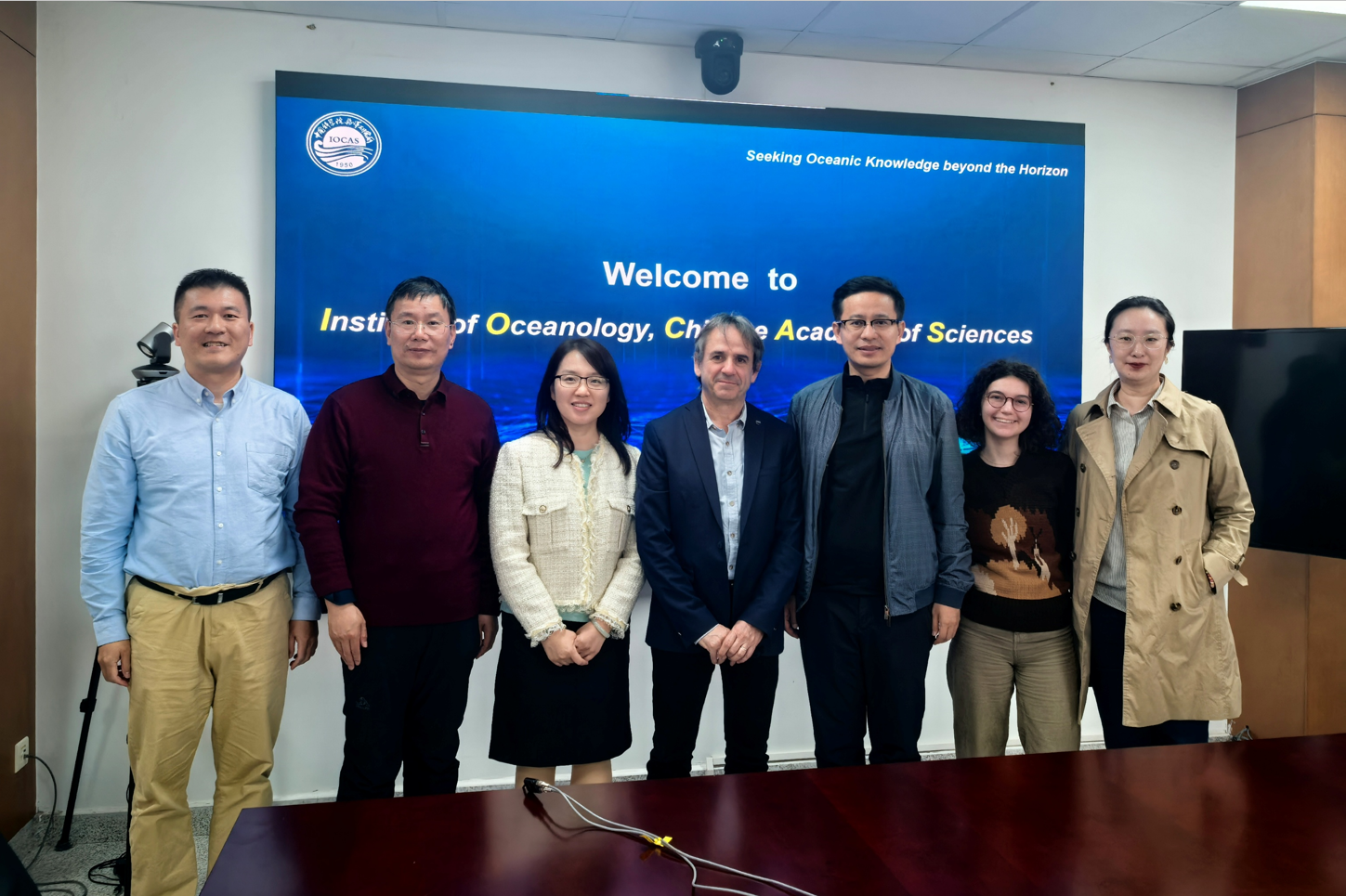
The meeting opened with welcome remarks and an institutional video introduction of IOCAS, followed by an introduction of CNRS by Dr. Fermin Cuevas, Director of CNRS in China. Prof. Jian Xu, Director of the Single-Cell Center and Director of the BioEnergy Division at QIBEBT, then presented “The iMAPS Initiative: Building an In-Situ-Metabolism-Based Global Network for Microbiome Observation and Mining.”
In his presentation, Prof. Xu introduced the vision of iMAPS as an international scientific program dedicated to mapping microbial metabolism directly at the single-cell level. By integrating in situ metabolic phenotyping, Raman-based single-cell analysis, AI-assisted data interpretation, and downstream cultivation and sequencing, iMAPS aims to establish a global network for microbiome observation, functional discovery, and resource mining.
The meeting also highlighted opportunities for Sino-French collaboration in marine science. Dr. Zhao Yuan from IOCAS presented ongoing cooperation between IOCAS and CNRS-affiliated institutes, emphasizing the strong foundation for future joint research. Ludivine Grand further shared recent research on plankton seascapes shaped by physical features in the Kuroshio–Oyashio frontal system, illustrating the importance of combining satellite and in situ observations in marine ecological studies.
Following the presentations, participants engaged in discussions with IOCAS research teams and explored potential areas for collaboration. The exchange provided a valuable opportunity to connect iMAPS with marine science, international cooperation, and microbiome research communities, supporting its broader mission to advance single-cell metabolic observation and global microbiome discovery.
